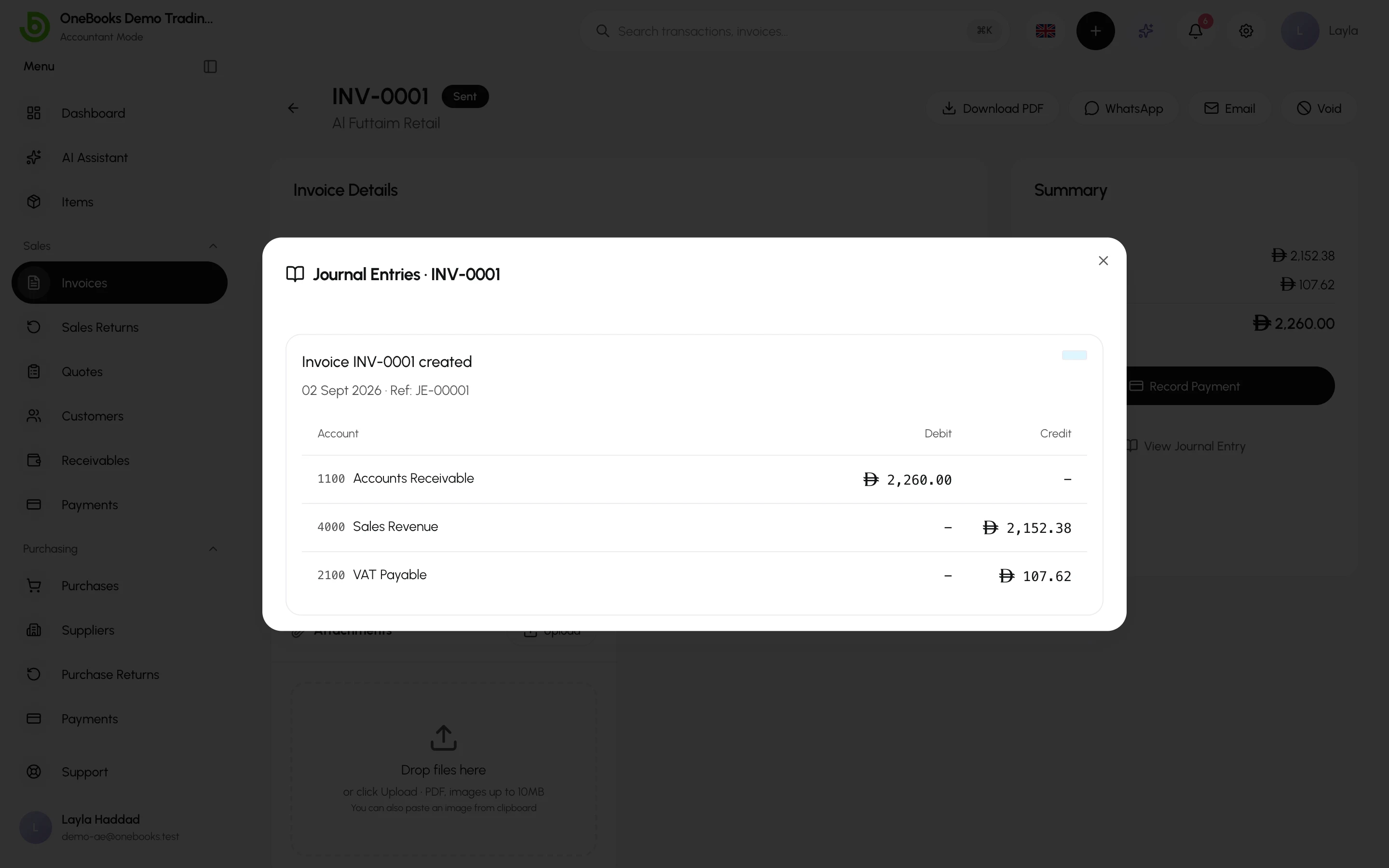
Every invoice, payment, purchase, expense and transfer in OneBooks becomes a journal entry: a set of lines where the debits equal the credits. Reports are computed live from those lines — there is no separate “report database” that can drift. This page explains the model in plain words; each module page lists its exact lines.
The building blocks
Section titled “The building blocks”- Accounts — the categories money moves between, organised in the chart of accounts. Each has a type: Asset, Liability, Equity, Revenue or Expense.
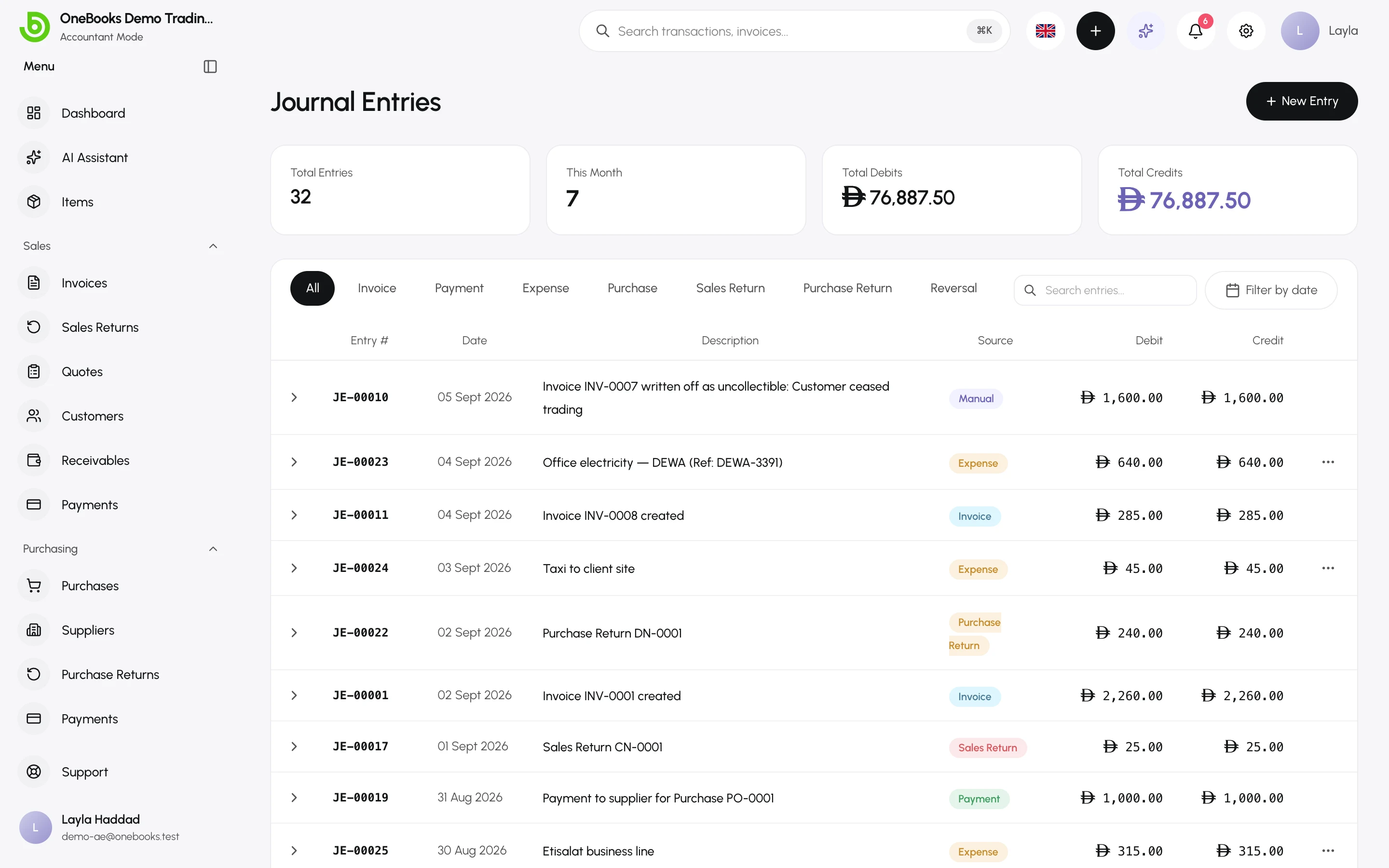
- Journal entry — one event, dated, with a source (invoice, payment, expense, purchase, manual…). Its lines always balance.
- Control accounts — 1100 Accounts Receivable totals what all customers owe; 2000 Accounts Payable totals what you owe all suppliers. The per-customer and per-supplier detail lives on the documents themselves.
What posts, and when
Section titled “What posts, and when”| Event | Debit | Credit |
|---|---|---|
| Invoice sent | 1100 Accounts Receivable | 4000 Sales Revenue, 2100 VAT Payable |
| Customer payment | 1200 Cash / 1210 Bank | 1100 Accounts Receivable |
| Credit note confirmed | 4000 Sales Revenue, 2100 VAT Payable | 1100 Accounts Receivable |
| Purchase finalized | 5000 Cost of Goods Sold (or the line’s account), 1300 VAT Receivable | 2000 Accounts Payable |
| Supplier payment | 2000 Accounts Payable | 1200 Cash / 1210 Bank |
| Debit note confirmed | 2000 Accounts Payable | 5000 Cost of Goods Sold, 1300 VAT Receivable |
| Expense | The expense account | 1200 Cash / 1210 Bank |
| Contra transfer | Destination cash/bank | Source cash/bank |
| Write-off | 5950 Bad Debt Expense | 1100 Accounts Receivable |
| Opening balance | The asset (or 3050 for a liability) | 3050 Opening Balance Equity (or the liability) |
Drafts post nothing. Quotes never post.
Corrections never edit history
Section titled “Corrections never edit history”A posted entry is never changed or deleted. Voiding an invoice, deleting a payment or expense, or reversing a manual entry posts a reversal — the same lines with debits and credits swapped — so the ledger keeps a complete audit trail. See Corrections.
Why the reports agree
Section titled “Why the reports agree”- Trial balance sums every account’s debits and credits — it always balances because every entry does.
- Profit and loss = revenue minus expense accounts for the period.
- Balance sheet = asset, liability and equity accounts at a date; retained earnings are reconstructed from all prior profit.
- Cash flow follows the 1200/1210 family and classifies movements as operating, investing (fixed assets) or financing (equity).
- Receivables and payables reports read the documents; the balance sheet reads the control accounts — both are built from the same postings, so they match.
Seeing the entries
Section titled “Seeing the entries”In Accountant mode every document offers View Journal, and Accounting → Journal Entries lists everything with its source. Select an entry to see its lines.